Commercial Floor Sanding in London, N15
Commercial floor sanding in London, N15 is rarely just a case of taking scratches out of a timber floor. Around Seven Sisters, South Tottenham, West Green Road and the southern stretch of Tottenham High Road, we regularly encounter worn lacquer, blackened traffic lanes, loose parquet, contaminated joints and old timber that has been repeatedly cleaned with unsuitable chemicals.
In an office, shop, restaurant, school, clinic, hotel or place of worship, a failing finish quickly becomes an operational problem. Bare timber absorbs spillages, open joints trap dirt, loose blocks become trip points and over-polished surfaces can become difficult to manage from a slip-risk point of view. Our Commercial Floor Restoration in London service deals with the condition of the timber first, then specifies the sanding sequence and coating system around the way the building is actually used.
We also provide planned Commercial Floor maintenance in London for floors that do not yet require full sanding, and Commercial Floor Polishing in London where an existing compatible finish can be cleaned, mechanically abraded and refreshed. The important part is knowing when a maintenance coat is technically sound and when somebody is simply putting another coating over a failed floor.

Commercial Parquet Floor Sanding London N15 – Before and After Mosaic Wood Flooring Restoration Near Seven Sisters and South Tottenham.
Commercial Timber Floors in N15: Wear We See on Site
N15 contains a mixture of late-Victorian and Edwardian building stock, converted houses, traditional shopfront premises, institutional buildings and later commercial units. Around Seven Sisters and Page Green in particular, older properties often contain suspended pine floors, pitch-pine boards or parquet that has survived several changes of use rather than being installed for the building’s present occupation.
The Seven Sisters/Page Green area includes surviving late-Victorian and Edwardian terraces, while Tottenham High Road remains one of the area’s main commercial routes. Floors close to busy entrances around Seven Sisters Road, West Green Road, Tottenham High Road and South Tottenham tend to suffer particularly hard from grit, wet footwear, wheeled deliveries and repeated cleaning.
We identify the timber before deciding how aggressively it can be treated. Quartersawn oak behaves differently from pitch pine; old teak can contain natural oils that affect coating adhesion; thin engineered oak cannot be treated like a 22 mm solid strip floor; and old parquet may have more trouble underneath it than is visible from the face.
Why Domestic Sanding Methods Fail on Commercial Floors
A domestic lounge may see slippers, a vacuum cleaner and occasional furniture movement. A restaurant aisle, office entrance, school corridor or retail unit may take thousands of loaded footsteps, abrasive grit, cleaning chemicals, chair movement, trolley wheels and repeated wet contamination.
That changes the specification. A light sanding followed by a domestic single-component varnish may look presentable on handover but can wear through rapidly at entrances and circulation routes. Likewise, applying an off-the-shelf polish over a degraded polyurethane coating can create patchy adhesion, contamination problems and an unnecessarily slippery film.
- Open board and parquet joints: trap food debris, cleaning residue, grit and moisture and can become unhygienic in cafés, clinics and education buildings.
- Loose parquet blocks: move under point loading and can break surrounding filler or lacquer if they are not properly re-bonded.
- Raised fixings and splintered boards: create snagging and trip risks in public circulation areas.
- Moisture ingress: can cause cupping, adhesive failure, dark staining and movement that sanding alone cannot correct.
- Incorrect coating build: may fail early under castor chairs, bar stools, gym equipment, delivery cages or concentrated entrance traffic.
- Slip performance: must be considered against the actual contamination expected in use rather than judged by whether a coating feels smooth to the hand.
- Historic timber: may already have lost considerable thickness through previous sanding and must be assessed before another heavy cut is attempted.
Our Step-by-Step Commercial Floor Restoration Process
Step 1: Subfloor Audit & Moisture Testing
Before a belt sander is unloaded, we establish what is happening below the finish. We check for deflection, hollow parquet, loose boards, failed fixings, perimeter movement, previous fillers, adhesive residue and areas where damp cleaning or building moisture may have affected the floor.
Where moisture is suspected, hygrometer checks form part of the investigation and readings are considered alongside the construction of the floor and subfloor. Sanding a damp timber floor flat can store up trouble because boards may change dimension again as moisture conditions stabilise.
On larger commercial projects we agree access, isolation areas, electrical supply, loading arrangements, waste routes and working hours before the programme begins. RAMS documentation can be prepared for the site, together with COSHH assessments covering dust, adhesives, fillers, primers, cleaning products and finishing materials.
Wood dust is a genuine occupational hazard, not simply a housekeeping issue. Our controls follow the principles set out by the Health and Safety Executive guidance on wood dust, with extraction, containment, suitable PPE/RPE and controlled cleaning incorporated into the working method.
Step 2: Timber Repairs, Re-bonding & Resin Gap-Filling
A commercial floor is only as sound as the material underneath the finish. Split floorboards are repaired or replaced with appropriately matched timber, protruding fixings are dealt with correctly and loose parquet is lifted where necessary rather than being sanded and lacquered in place.
For parquet re-bonding we can use suitable silane-based flexible parquet adhesives where the substrate and existing construction allow. Their elastic characteristics accommodate limited timber movement better than trying to rigidly lock every block to the base, but the adhesive is selected to suit the substrate, block size and service conditions rather than by brand name alone.Fine stable gaps can be treated using resin-slurry gap filling produced from clean sanding dust of the appropriate timber and a compatible resin binder. Wider moving joints need a different repair strategy; forcing resin into a seasonal 6 mm board gap is not craftsmanship, because the filler is likely to crack or be pushed out when the timber moves.
Large gaps in traditional pine floors may be dealt with using timber slivers where appropriate. We determine the repair method after inspecting movement, ventilation below suspended floors and the remaining condition of the board edges.
Step 3: HEPA Dust-Controlled Sanding & Surface Preparation
For the main cut we use professional belt-sanding equipment such as the Lägler Hummel rather than lightweight domestic hire machines. Correct belt tracking, abrasive selection, feed rate and machine direction matter on oak, pitch pine and older strip flooring because aggressive cross-grain sanding can leave damage that becomes more obvious after coating.The initial abrasive grade is selected from the actual condition of the floor. A badly cupped old pine floor with adhesive contamination may need a substantially different starting sequence from a flat oak office floor requiring the removal of a tired lacquer system.
Successive cuts remove the previous scratch pattern rather than simply making the floor lighter in colour. Edges, corners, radiator areas and thresholds are blended into the field sanding before the final preparation stage, and the floor is thoroughly vacuumed before coating.Our commercial set-up uses high-efficiency extraction, including HEPA H14 filtration where specified for sensitive or occupied environments. Extraction at source is particularly important in clinics, schools, offices, hotels, retail premises and buildings where neighbouring rooms may remain operational.

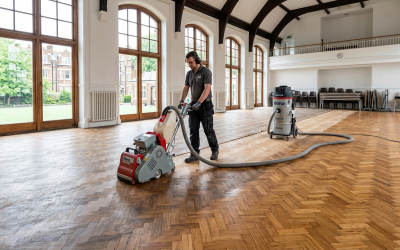
Expert commercial floor sanding in London N15, restoring parquet wood floors to a smooth, clean finish with professional sanding equipment.
Step 4: High-Traffic Finishes, 2K Lacquers & Anti-Slip Options
The finishing system is selected from expected traffic, cleaning regime, appearance, downtime and future maintenance. For heavily used commercial timber floors, a correctly specified 2K waterborne polyurethane is often the practical choice because the cross-linking catalyst produces a tougher cured film than a basic single-component domestic lacquer.
We measure and mix two-component products to the manufacturer’s stated ratio and pot life. Guessing catalyst quantities or stretching mixed lacquer beyond its usable working time can affect curing, adhesion and film performance even when the surface initially appears satisfactory.
Hardwax oil can be a good specification for certain offices, boutiques, hospitality spaces and heritage timber where appearance and localised maintenance are priorities. It is not automatically the right answer for every commercial floor, particularly where aggressive chemical cleaning, standing water or very intense abrasion is expected.
Where slip risk is a concern, the coating and maintenance system can be specified with the required level of surface resistance in mind. The established BS 7976-2 pendulum approach is now represented within BS EN 16165:2021 Annex C; for commercial premises we prefer measurable slip-risk assessment over vague descriptions such as “non-slip lacquer”.
For occupied or sensitive premises we can also consider low-emission installation products, including adhesives carrying an EC1 Plus classification where the technical specification calls for them. EC1 Plus is a stringent emissions class for flooring installation products, and further technical information is available from GEV EMICODE.
Step 5: Cure Times, Handover & Maintenance Protocols
Dry is not the same as cured. A waterborne commercial lacquer can often accept careful foot traffic considerably earlier than heavy furniture, castor chairs, rugs, wheeled equipment or wet cleaning, and we provide a reopening schedule based on the actual finishing system used.
Where a business cannot close completely, we can phase the works so completed zones are protected while another area is restored. Restaurants may be programmed around closed days, offices around weekends or night shifts, and schools or places of worship around term dates, services and booked events.
Once the floor is back in use, the biggest cause of premature wear is often poor maintenance rather than a defective coating. Entrance matting, correct dilution of cleaning chemicals, prompt removal of spillages, felt or suitable furniture protection and avoiding repeated application of incompatible polish can materially extend the life of the finish.
A floor that has not yet worn through to bare timber may only require a deep clean, mechanical screen and compatible maintenance coat. That approach can postpone another full sanding cycle and is particularly useful for larger commercial sites where preserving timber thickness matters.
Working Around Live Commercial Premises in London N15
Closing a shop, practice, office or hospitality venue costs money, so programme planning is part of the restoration job. We agree working zones, noise-sensitive periods, cure windows and handover times before committing to a sequence.
| Working Arrangement | Operational Benefit | Typical Facilities |
|---|---|---|
| Overnight Works | Sanding and preparation take place after customers and staff leave, allowing noisy operations to be completed outside normal trading hours. Finish selection is planned around the available cure window. | Retail units, restaurants, cafés, offices, clinics, gyms and showrooms |
| Weekend Phased Works | Larger areas can be isolated on Friday evening, restored through the weekend and handed back according to the coating manufacturer’s traffic and cure requirements. | Corporate offices, schools, colleges, dental practices, studios and serviced offices |
| Sectional Restoration | The floor is divided into controlled zones so part of the premises can remain operational. Transitions and coating overlaps are planned before work starts. | Hotels, hostels, factories, warehouses, event venues, places of worship and larger education buildings |

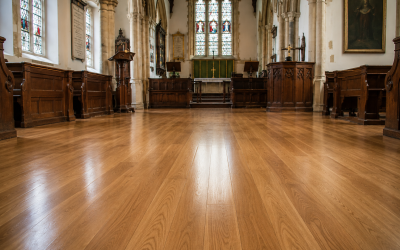
Commercial Floor Sanding London N15 – Before and After Solid Wood Floor Restoration in a Gallery and Exhibition Space
Commercial Floor Sanding for Different N15 Premises
Offices, Coworking Spaces & Serviced Offices
Desk chairs, wheeled storage, concentrated walkway traffic and entrance grit tend to wear through office coatings in predictable zones. We can restore whole floors during shutdown periods or work in phases around occupied departments, with particular attention to reception areas, corridors and kitchen approaches.
Shops, Boutiques, Showrooms & Shopping Units
Retail flooring has to cope with wet footwear, grit, deliveries, display changes and constant concentrated footfall. Finish choice therefore needs to consider abrasion resistance, appearance under strong lighting and how quickly the floor needs to return to service.
Restaurants, Cafés, Pubs & Takeaway Units
Hospitality floors suffer from grease, dropped drinks, chair movement and repeated cleaning. Open parquet joints and worn coatings are particularly troublesome around bars, counters and service routes, so we deal with structural defects before attempting to improve the appearance.
Factories, Workshops, Storage Units & Distribution Premises
Where timber survives in older industrial or workshop buildings, it often carries years of oil, impact damage and localised repairs. We first determine whether contamination can be mechanically removed and whether sufficient sound timber remains for restoration before recommending sanding.
Gyms, Cinemas, Studios & Event Venues
These spaces commonly combine heavy traffic with equipment movement and short turnaround periods between bookings. Coating specification, drying time and any required slip performance must therefore be agreed before the work is scheduled.
Hotels, Hostels & Serviced Accommodation
Corridors, reception floors and communal rooms can rarely be taken out of service without planning. Sectional working and low-dust preparation help limit disruption, while tougher finish systems can be concentrated on luggage routes and entrances.
Clinics, Dental Practices & Treatment Rooms
Dust control, cleanability and product emissions deserve extra attention in healthcare and treatment environments. We isolate work areas, extract sanding dust at source and agree cleaning and reopening procedures with the site manager before handover.
Schools, Colleges, Universities & Academies
Education floors often combine very old parquet with exceptionally heavy use. Assembly halls, classrooms, corridors and common areas may require block repairs, local board replacement, heavy-duty finishing and carefully planned work during holidays or weekend closures.
Churches, Mosques, Temples & Community Buildings
Places of worship can contain excellent old pitch pine, oak strip or parquet that has been patched repeatedly over many decades. We retain sound original material wherever practical and schedule noisy or odorous operations around services, prayers, ceremonies and community bookings.
Local Knowledge Around Seven Sisters, South Tottenham & N15
N15 is not uniform building stock. Around the Seven Sisters/Page Green area there are Victorian and Edwardian terraces and long-established high-street buildings, while commercial premises towards Tottenham High Road and West Green Road range from converted older properties to heavily altered retail and mixed-use units.
Older suspended timber floors can hide poor previous repairs, redundant hearth openings and movement caused by ventilation or moisture conditions beneath the boards. In old institutional buildings the floor may instead be substantial hardwood parquet laid in bituminous adhesive, while later refurbishments may contain engineered timber over concrete or screed.
This is why we do not price serious commercial restoration from square metres alone. Access, existing finish, timber thickness, failed adhesive, repair quantity, furniture clearance, working hours and required finish all affect the labour and programme.
Health, Safety & Site Documentation
Commercial work needs proper paperwork as well as good sanding. Our site arrangements can include RAMS, COSHH information, equipment controls, dust management, work-zone isolation and agreed access routes, with CSCS-carded operatives available for sites where contractor competency controls require them.
For public-facing floors, slip risk should be considered in relation to foreseeable use and contamination. Where testing is specified, pendulum testing under the current BS EN 16165:2021 Annex C method can provide a recognised basis for assessing surface slip resistance rather than relying on subjective claims.
We also carry commercial liability insurance and can provide the relevant documentation during the quotation or contractor approval process. Site managers are told what products are proposed, what access is needed, how long individual stages take and when the restored floor can safely return to its intended use.
Quotations Without Guesswork
A useful initial assessment can normally be made from clear photographs, short videos and a floor plan showing approximate dimensions. That allows us to identify obvious parquet failure, board damage, heavy coating build, access restrictions and areas that need closer inspection.
For commercial projects we then recommend a physical site survey before the final scope is fixed, particularly where moisture, structural movement, historic timber or substantial repairs are involved. The written quotation can separate sanding, repairs, gap filling, staining, coating upgrades and any out-of-hours working so facilities managers can see what is being allowed for.
You can review examples of previous timber work in our floor sanding gallery. For budgeting before a survey, our floor sanding and restoration prices page gives current guideline rates for sanding, finishes, gap filling and maintenance work.
Why Commercial Clients Use London Floor Sanding
- Commercial timber-floor experience across offices, retail, hospitality, education, healthcare and public buildings.
- Professional Lägler Hummel belt sanding and commercial-grade edge and finishing equipment.
- HEPA H14 dust extraction available for sensitive commercial environments.
- Repairs to floorboards, parquet and damaged timber before cosmetic refinishing begins.
- Resin-slurry filling, timber slivering and flexible repair methods selected according to joint movement.
- 2K waterborne polyurethane, hardwax oil and specialist high-traffic finish specifications.
- Silane-based flexible parquet adhesives where appropriate to the floor construction.
- COSHH assessments and RAMS available for managed commercial sites.
- Out-of-hours, weekend and phased programmes available subject to project requirements.
- Photo or video assessment followed by a physical commercial survey where required.
- Commercial liability insurance and site documentation available for contractor approval.

Arrange a Commercial Floor Survey in London, N15
If your timber floor is worn through, loose, difficult to clean or becoming a safety and maintenance problem, send us photographs before spending money on another polish or temporary coating. We can usually tell from a short video whether the floor is likely to need maintenance, local repairs or full sanding and refinishing.
Call 0800 335 7565 to discuss the premises, approximate floor area, opening hours and required completion date. You can also send site photographs, video and floor plans by WhatsApp or email so we can prepare for the survey and advise on the most practical working programme.